
Orcher · Integration
Enterprise Integration Fabric
Orcher is not a destination system. It is the governed path between the systems of record an enterprise already trusts and the providers it does not.
Vol. I · p.14
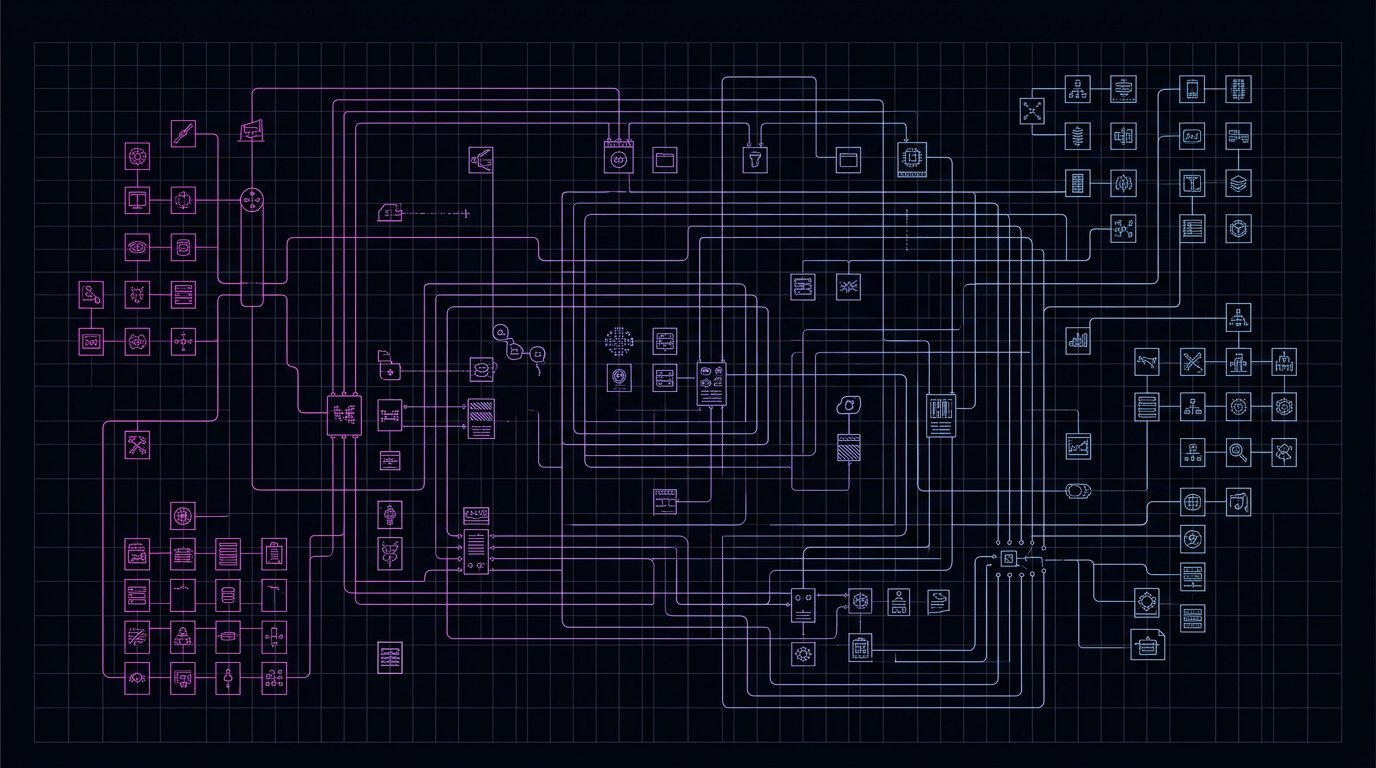
Figure · Orcher™
Orcher Enterprise Integration Fabric
FIG. P14-01
01
Cloud platforms
AWS, Azure, Google Cloud and private cloud estates.
02
Data & analytics
Warehouses, lakehouses and BI semantic layers.
03
Frontier model providers
Every major provider, reached provider-neutrally.
04
ERP
The financial and operational book of record.
05
CRM
Customer commitments and contractual state.
06
HCM
Roles, entitlements and employment status.
07
Supply chain
Inventory, logistics and supplier obligations.
08
Financial management
Treasury, payables and controls.
09
Collaboration
The systems where directives are actually issued.
10
ITSM
Change control and incident state.
11
Identity & security
The authority Orcher binds a directive to.
The interface problem
The average enterprise runs 354 APIs. Governance runs on none of them.
Integration sprawl is not a cost line — it is the reason authority cannot be traced. Every point-to-point connection is a place where a directive loses its owner.
354
APIs in the average enterprise estate
14+
AI tools already in use across a typical organization
$45k–$120k
cost per bespoke integration
>$100B
annual losses attributed to poor interface governance
Consolidation
One fabric replaces the mesh.
Deployments to date consolidate a median of six to eleven point-to-point integrations into a single governed path. Bringing a new system under the Role Identity Fabric takes under two business days.
At $45,000 to $120,000 per integration, the mesh an enterprise has already built represents $1.26M to $5.04M of sunk interface work — none of which carries a role, a directive, or an evidence chain. Orcher does not ask that estate to be rebuilt. It terminates the connections that matter into one path where authority is checked before a write, not reconstructed after an incident.
The fabric is provider-neutral by construction. A control plane owned by a model vendor cannot credibly refuse that vendor's model; Orcher has no model to defend.
Dipp AI Research: internal analysis, not independently verified.
Coverage
Eleven system categories, one authority model
Cloud platforms
AWS, Azure, Google Cloud — compute, storage, and the identity planes attached to them.
Data & analytics
Warehouses, lakehouses, and BI systems that hold the numbers a directive must reconcile against.
Frontier model providers
Multiple providers, routed by stakes rather than by contract lock-in.
ERP
The financial system of record. Nothing commits here without pre-commit verification.
CRM
Customer records, pipeline, and the entitlements that constrain what an agent may promise.
HCM
The authoritative source of who holds which role — the input the Role Identity Fabric binds to.
Supply chain
Inventory, procurement, and logistics systems where an unverified write becomes a physical event.
Financial management
Treasury, payables, and close processes carrying direct statutory exposure.
Collaboration
Where directives are actually issued — and where oversight theater usually begins.
ITSM
Change management and incident systems that must receive evidence, not screenshots.
Identity & security
IdP, PAM, SIEM, and DLP — Orcher consumes them and emits back into them.
Provider neutrality
No provider grades its own homework.
Ten platform vendors are converging on the control layer. None of them is neutral across agent identity, runtime verification, cross-provider reach, and cost-aware routing at once.
Figure · Orcher™
Vendor convergence matrix
FIG. P21-02
| Vendor | Agent identity | Runtime verification | Cross-provider | Cost-aware routing |
|---|---|---|---|---|
| Microsoft | Yes | Partial | No | Partial |
| Partial | No | No | Partial | |
| AWS | Partial | Partial | No | Partial |
| ServiceNow | Yes | No | No | No |
| Salesforce | Yes | No | No | No |
| IBM | Partial | Partial | Partial | No |
| Oracle | Partial | No | No | No |
| SAP | Partial | No | No | No |
| Palantir | Partial | Partial | No | No |
| UiPath | Partial | No | Partial | No |
| Orcher — Dipp AI | Yes | Yes | Yes | Yes |
Integrate once, govern everywhere.
The fabric carries the directive, the role, and the evidence chain across every provider it touches.