
Orcher · Component 03 of 07

Logic Scrubber

Verifies the proposed action against systems of record before commit.

Layer 1 — sequential, gating

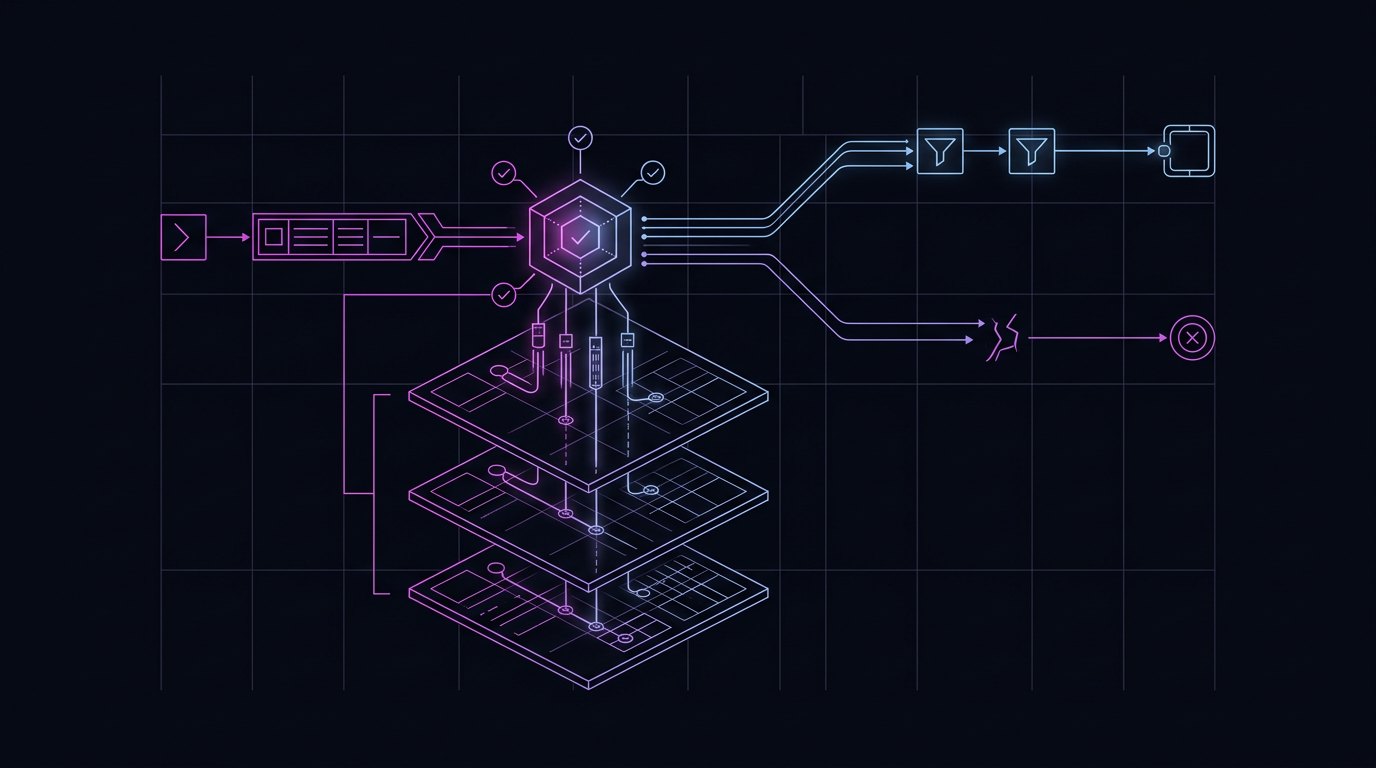
A proposed action checked against systems of record, one path passing and one halted
Verifies the proposed action against systems of record before commit.

The Logic Scrubber runs in a separate process boundary from the agent that proposed the action. It checks the proposed write against the systems of record it will touch — the policy, the balance, the eligibility, the contract — and refuses anything that does not reconcile. This is the component that turns a model that will not misbehave into a system that cannot.

  • Re-derives the proposed action's preconditions from systems of record.
  • Runs outside the agent's process boundary, so a compromised agent cannot bypass it.
  • Halts the directive on failure. Nothing partial is written.
  • Returns the reason for refusal as structured evidence, not a generic error.

Without it, review is theater

A human approver facing hundreds of plausible-looking actions approves nearly all of them. Verification against a system of record does not fatigue.

What it emits

A verification result: pass with evidence, or halt with the reconciliation that failed.

Evidence

What the record shows

Figures drawn from the Enterprise Superintelligence Report, Vol. I, August 2026.

45.5%

human accuracy on cases where AI advice was wrong, versus 82% unaided

automation bias — Vol. I, p.6

2,992

alerts per day in the analogous security-operations case

37% investigated — Vol. I, p.7

30s

typical gateway approval timeout before an action auto-proceeds

Vol. I, p.7

Mechanism

How it works

Four stages, in order. Layer 1 components gate execution; Layer 2 components run continuously and never block.

  1. 01

    Intercept the proposed write

    The agent produces a proposed action, not a committed one. Nothing reaches a system of record until the Scrubber has cleared it.

  2. 02

    Re-derive preconditions

    Running in a separate process boundary, the Scrubber independently re-derives the facts the action depends on — the policy status, the balance, the eligibility, the contract term — from the systems of record themselves.

  3. 03

    Reconcile

    The re-derived facts are compared against the assumptions embedded in the proposed action. Any mismatch is a failure, regardless of how plausible the agent's output reads.

  4. 04

    Pass or halt

    A pass carries structured evidence into the ledger. A halt is total: nothing partial is written, and the reason is returned as a structured reconciliation failure rather than a generic error.

Operational contract

Input
Proposed action plus its stated preconditions
Output
Verification result — pass with evidence, or halt with the failed reconciliation
Mode
Layer 1 — sequential, gating
Isolation
Separate process boundary from the proposing agent
Write semantics
All-or-nothing; no partial commits
Evidence
Machine-readable reconciliation record attached to the cycle

What it is not

It is not a second model reviewing the first

Model-checks-model inherits the same failure modes and the same blind spots. The Scrubber checks against systems of record, which do not hallucinate.

It is not a human approval queue

Approval gates that time out after thirty seconds and present hundreds of plausible actions produce rubber-stamping. Verification against a source of truth does not fatigue.

Failure behaviour

A Scrubber that cannot reach a system of record fails closed. An unverifiable action is treated identically to a failed one: the directive halts.

Questions

What enterprises ask first

Why not just have a person review the action?
Unaided human accuracy on these cases is around 82%. When wrong AI advice is present, it drops to 45.5%. Review is where automation bias does its damage; verification is where it does not apply.
What counts as a system of record?
Whatever the enterprise treats as authoritative for the fact in question — the core policy administration system, the ledger, the EHR, the contract repository, the entitlement store.
Can the agent bypass the Scrubber?
No. It runs outside the agent's process boundary and holds the write path. A compromised agent can propose anything it likes and still commit nothing.
What does a halt cost us operationally?
A halt returns a structured reason, so the professional sees precisely which fact did not reconcile. That is materially cheaper than discovering the same mismatch in a remediation programme months later.

Where it shows up

Solutions and industries that depend on this

Surfaced automatically from the components each solution engages and each industry relies on.

The other six

Orcher is one control plane

Verified execution, or none at all.

Orcher is deployed with named enterprises under the Human-in-the-Role model. Request a technical briefing with the founding team.